
Atlantic premiere event:
View event time in your local Atlantic timezone
Pacific replay event:
View event time in your local pacific timezone
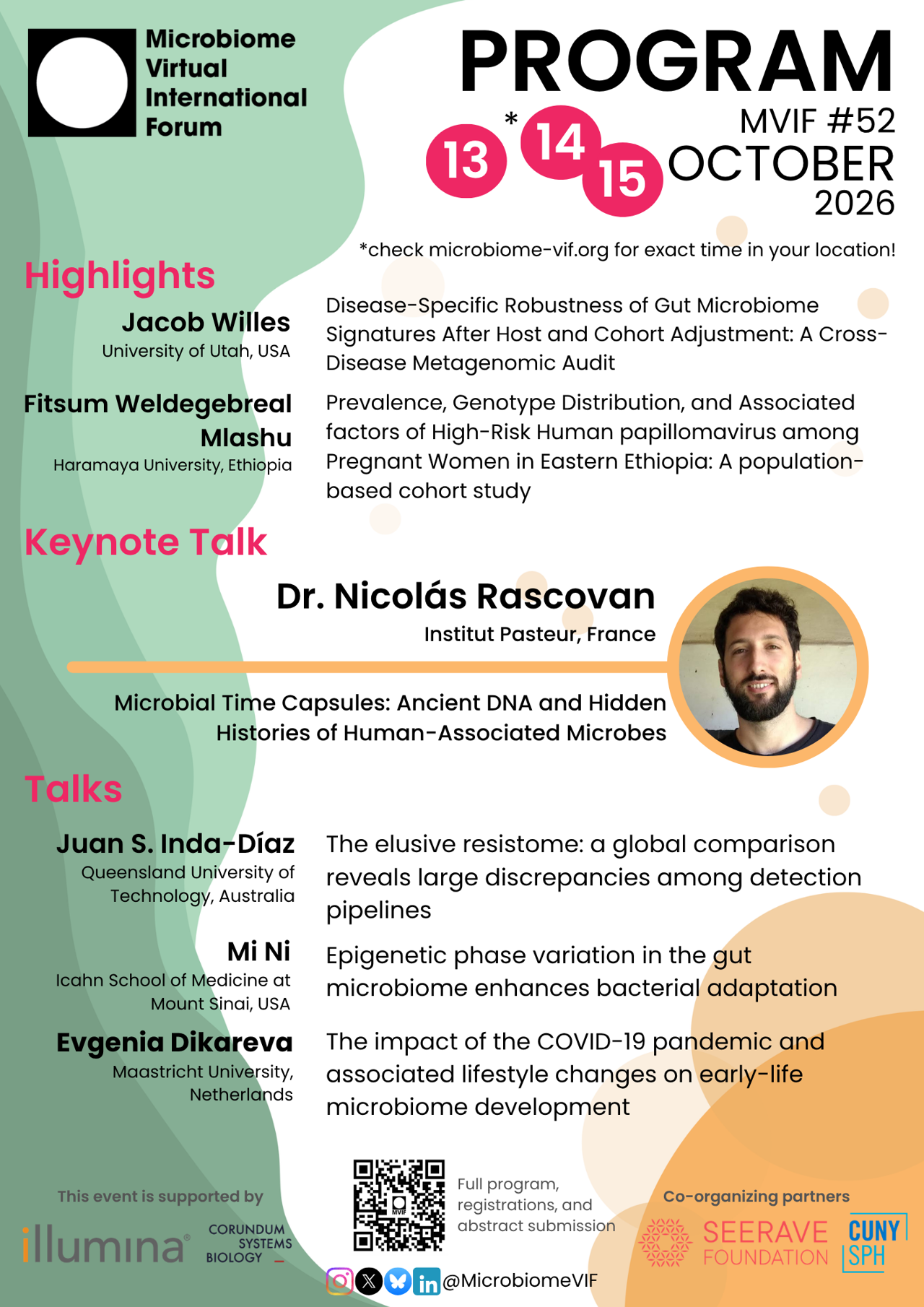
Keynote talk
Microbial Time Capsules: Ancient DNA and Hidden Histories of Human-Associated Microbes
By Dr. Nicolás Rascovan, Institut Pasteur, France
Human-associated microbes have shaped our history, but much of their past diversity remains invisible if we only study present-day populations. Pathogens disappear, lineages go extinct, reservoirs shift, and microbial communities are transformed by demographic processes such as migration, colonization and bottlenecks; lifestyle changes such as agriculture, urbanization and industrialization; and broader environmental change. Ancient DNA provides a unique way to recover this missing temporal dimension by reconstructing microbial genomes directly from archaeological remains, dental calculus and historical objects.
In this talk, I will present how microbial paleogenomics can reveal the deep history of human-associated microbes, with a particular focus on selected work from my lab on ancient pathogens in the Americas. I will discuss how ancient and modern microbial genomes can reshape our understanding of when, where and how infectious diseases circulated in the past, especially in contexts where written records are absent, incomplete or filtered through colonial narratives. The talk will explore how ancient DNA can reveal hidden pathogen diversity, unexpected reservoirs, long-distance microbial dispersal and the infectious burden associated with major historical processes such as mobility, agricultural change, colonization, war and socioeconomic crisis. More broadly, I will argue that past pathogens are not only markers of disease, but also biological traces of human history, ecological change and long-term human–microbe interactions.
Together, these perspectives show that archaeological material can act as a microbial archive, preserving traces of infections, host movements and changing human–microbe interactions. I will close by discussing how ancient oral microbiomes may provide a complementary window into past lifestyles, population contacts and long-term microbiome evolution, opening new perspectives for microbiome research across time.
Highlights
Disease-Specific Robustness of Gut Microbiome Signatures After Host and Cohort Adjustment: A Cross-Disease Metagenomic Audit
By Jacob Willes, University of Utah, USA
"Background: Gut microbiome signatures are increasingly studied as biomarkers across gastrointestinal and metabolic disease, but observed associations may be driven by host characteristics and cohort structure. We evaluated whether microbiome features provide disease-specific predictive information beyond standard host and study metadata.
Methods: Public stool shotgun metagenomic profiles from curatedMetagenomicData were analyzed for type 2 diabetes (T2D), inflammatory bowel disease (IBD), colorectal cancer (CRC), and colorectal adenoma (CRA). Only studies containing both disease and healthy samples were included. Species-level relative-abundance features present in at least 10% of samples were evaluated. Five-fold cross-validation compared metadata-only models (age, body mass index, sex or gender, and country), microbiome-only models, and full models adding microbiome features and study fixed effects. Independent microbiome contribution was defined as the full-model area under the receiver operating characteristic curve (AUC) minus the metadata-only AUC. Bootstrap 95% confidence intervals (CIs), host/cohort matching, and within-study label permutation assessed robustness.
Results: The analysis included 4,773 observations: 1,264 T2D, 1,763 IBD, 1,229 CRC, and 517 CRA. IBD showed the largest independent microbiome contribution (metadata AUC, 0.677; full-model AUC, 0.944; incremental AUC, 0.266; 95% CI, 0.240–0.294). CRC also retained predictive value (0.580 vs 0.729; incremental AUC, 0.149; 95% CI, 0.116–0.191). In contrast, microbiome features did not improve prediction for T2D (0.865 vs 0.846; incremental AUC, −0.018; 95% CI, −0.037–0.000) or CRA (0.687 vs 0.554; incremental AUC, −0.133; 95% CI, −0.190 to −0.076). In matched analyses, full-model AUC remained high for IBD (0.960) and CRC (0.711), while CRA remained near chance (0.510). Within-study permutation reduced full-model AUC to 0.503 for CRC and 0.632 for IBD, while T2D and CRA retained greater metadata-related structure.
Conclusions: Independent microbiome predictive value differed substantially by disease. IBD and CRC retained microbiome-specific signals after host and cohort adjustment, whereas T2D and CRA did not. Cross-disease microbiome biomarker studies should benchmark microbial models against metadata-only baselines and use cohort-aware sensitivity analyses before interpreting microbiome signatures as disease-specific.
Prevalence, Genotype Distribution, and Associated factors of High-Risk Human papillomavirus among Pregnant Women in Eastern Ethiopia: A population-based cohort study
By Fitsum Weldegebreal Mlashu, Haramaya University, Ethiopia
"Background: High-risk human papillomavirus (HR-HPV) infection is the principal cause of cervical precancer and cancer. Although Ethiopia introduced the quadrivalent Gardasil® HPV vaccine targeting types 6, 11, 16, and 18, data on HR-HPV genotype distribution and theoretical vaccine coverage remain limited. We assessed HR-HPV prevalence, genotype distribution, theoretical vaccine coverage, and associated maternal factors among apparently healthy pregnant women in eastern Ethiopia.
Methods: This study was nested within the EthiOMICS cohort, a population-based longitudinal study of pregnant women recruited at 12–22 weeks of gestation from the Hararghe Health and Demographic Surveillance System Site. Vaginal swabs were collected from 217 women, genomic DNA was extracted, and HR-HPV detection was performed using the Seegene Allplex™ HR HPV assay targeting 14 high-risk genotypes. Data were analyzed using SPSS version 28.
Results: HR-HPV prevalence was 12.9% (95% CI: 8.8–18.1), and 35.7% of the 28 HR-HPV-positive women had multiple genotypes. HPV16 and HPV66 were the most common genotypes (21.4% each), followed by HPV31, HPV58, and HPV51 (17.9% each). The quadrivalent vaccine theoretically covered 25.0% of HR-HPV-positive women, whereas Gardasil 9® coverage increased to 71.4%. Younger maternal age, earlier sexual debut, bacterial vaginosis, and concurrent infection with Ureaplasma urealyticum, Ureaplasma parvum, and Mycoplasma hominis were independently associated with HR-HPV infection.
Conclusions: More than one in eight pregnant women harbored HR-HPV, with substantial genotype diversity and frequent multiple infections. The limited theoretical coverage of the quadrivalent vaccine supports consideration of broader-valency vaccines and continued molecular surveillance to strengthen cervical cancer prevention in Ethiopia."
Talks
The elusive resistome: a global comparison reveals large discrepancies among detection pipelines
By Juan S. Inda-Díaz, Queensland University of Technology, Australia
Identifying antibiotic resistance genes (ARGs) from metagenomic data is critical for studying antimicrobial resistance across microbial communities and pathogens. However, there is no standardized methodology for ARG annotation. Here, we compare ten commonly used ARG detection pipelines by analysing over 270 million prokaryotic genes from the Global Microbial Gene Catalogue across 13 distinct habitats. We observed up to a 45-fold difference in the number of reported ARGs, with a mean Jaccard index of only 16% between pipelines. Pipeline selection profoundly impacted downstream biological interpretations, with drastic changes to estimates of ARG relative abundance and richness, to the characterization of pan- and core-resistomes, and to the class-level composition of the inferred resistome. ARG detection pipelines make different, defensible trade-offs, and no single approach should be treated as authoritative. Therefore, users should justify and communicate choices carefully, as our analyses show that, taken uncritically, the same data can support conflicting biological and ecological interpretations.
Epigenetic phase variation in the gut microbiome enhances bacterial adaptation
By Mi Ni, Icahn School of Medicine at Mount Sinai, USA
"The human gut microbiome continuously adapts to fluctuations in diet, medication, and host physiology, yet the mechanisms enabling rapid bacterial adaptation remain incompletely understood. Epigenetic phase variation (ePV), mediated by DNA methylation, can generate phenotypic heterogeneity within clonal bacterial populations, but its prevalence and functional roles in commensal gut bacteria are largely unexplored.
Here, we systematically characterize ePVs across the human gut microbiome using long-read metagenomics coupled with integrative transcriptomic analysis. We identify both genome-wide and site-specific ePVs, including genome-wide methylation switching driven by structural variation of DNA methyltransferases. Analysis of large-scale public metagenomic datasets reveals that such genome-wide ePVs are widespread across both healthy and disease-associated microbiomes.
We further show that ePVs dynamically respond to environmental perturbations, including antibiotic exposure, fecal microbiota transplantation, and probiotic engraftment. Focusing on an Akkermansia muciniphila isolate, we identify a specific ePV regulating mucC, whose expression enhances bacterial tolerance to antibiotics, consistent with a bet-hedging adaptive strategy.
Together, our findings uncover epigenetic heterogeneity as a pervasive and functionally important mechanism of bacterial adaptation in the human gut, providing a new framework for understanding microbiome dynamics in health and disease."
The impact of the COVID-19 pandemic and associated lifestyle changes on early-life microbiome development
By Evgenia Dikareva, Maastricht University, Netherlands
"Introduction: The infant gut microbiota (GM) has a lifelong impact on health. The roles of genetics, prenatal factors, and environmental influences in shaping the trajectory of microbiota maturation have been well-studied. The COVID-19 pandemic presented a unique opportunity to investigate how changes in behavior: social interactions, protective measures, and hygiene practices affect the GM. To explore these effects, we developed a specific index to assess their influence.
Methods: We collected fecal samples and questionnaire data from 139 infants as part of the Dutch longitudinal LucKi Birth Cohort Study, which explores microbiota development over the first 14 months of life. We used PERMANOVA to identify factors influencing infant GM development and conducted differential abundance analysis based on linear regression to examine the abundance of bacterial species. To investigate whether the behavior was associated with the microbiota, we used the constructed index to correlate it with the species abundance.
Results: We found that samples collected at the same age differed in microbiota composition depending on whether they were collected before or after the onset of the pandemic (PERMANOVA, 6 months, p-value: 0.022, R²: 0.017). Several bacterial species showed differences in abundance in samples collected during the pandemic. Alpha diversity was significantly lower at 9 months of age in pre pandemic samples. The index revealed that limited adherence to infection prevention and control measures was associated with lower abundances of Gordonibacter pamelaeae.
Conclusion: This study highlights the pandemic’s impact on infant GM, with differences in profiles observed before and after its onset. These changes can be attributed to behavioral shifts, such as social distancing and hygiene practices, which may alter specific bacterial strains. Our findings emphasize the importance of considering how large-scale public health interventions, like those implemented during the pandemic, might unintentionally influence early-life GM development, potentially leading to downstream effects on health."