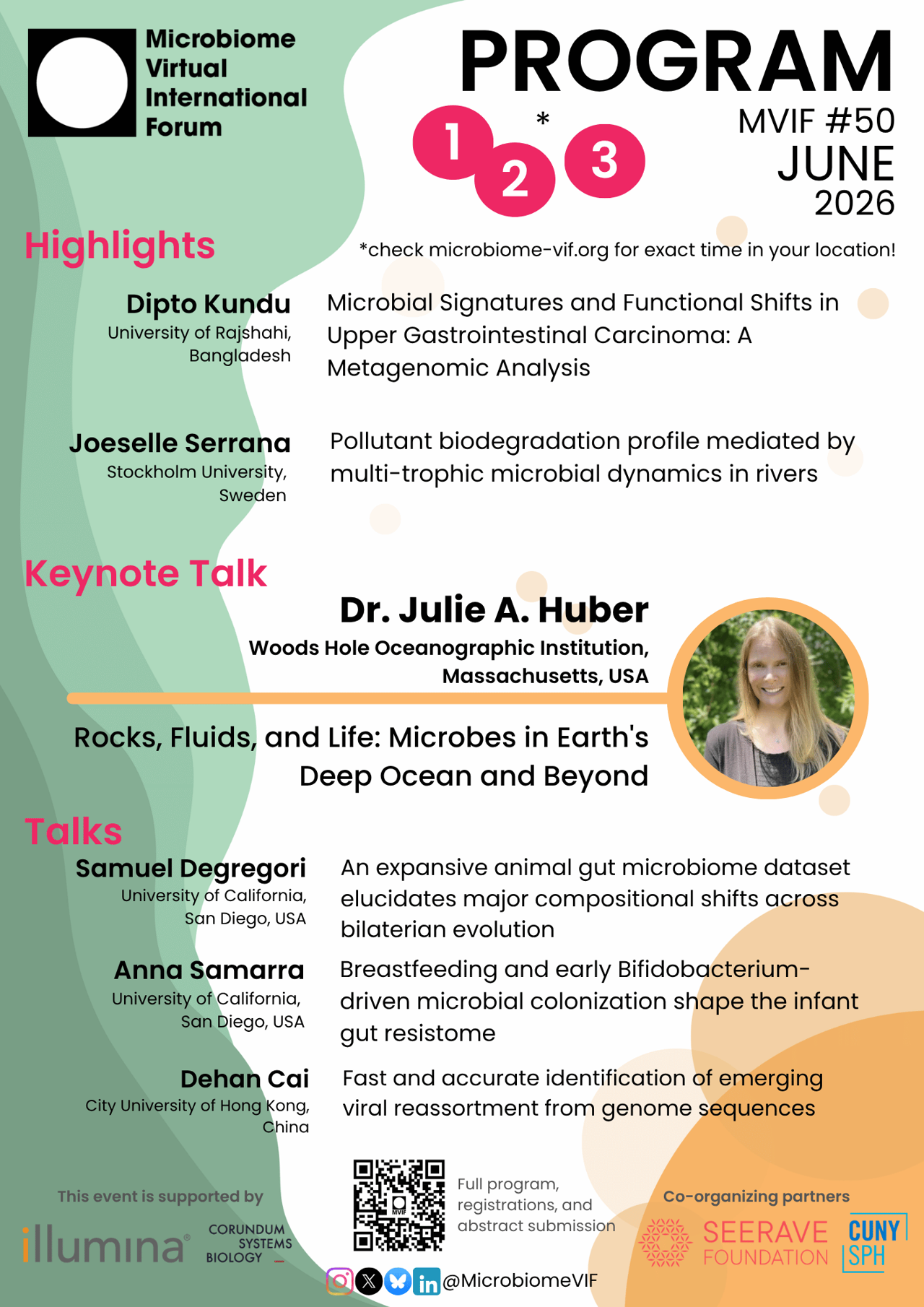

Keynote talk
Rocks, Fluids, and Life: Microbes in Earth's Deep Ocean and Beyond
By Dr. Julie A. Huber, Woods Hole Oceanographic Institution, Massachusetts, USA
Highlights
Microbial Signatures and Functional Shifts in Upper Gastrointestinal Carcinoma: A Metagenomic Analysis
By Dipto Kundu, University of Rajshahi, Bangladesh
"Introduction: Upper gastrointestinal (UGI) carcinoma is one of the significant causes of global cancer mortality, in which the human microbiome plays a crucial role in the immune system and inflammation. Previously, the focus of taxonomic variation was on analyzing taxonomic variation, and differential taxa were reported to be linked with the UGI cancer, but the functional structure of microbial communities, especially in biopsy and mucosal swab samples, is not well-characterized. The study will examine microbial richness, evenness, differential biomarkers, and changes in functional pathways associated with UGI carcinoma using high-resolution 16S rRNA metagenomic profiling data. Methodology: Publicly available 16S rRNA sequencing data were collected from the ENA Browser and processed using the DADA2 denoising pipeline within QIIME2, including quality filtering, chimera removal, and rarefaction. A total of 2,461 high-quality amplicon sequence variants (ASVs) and 282 samples passed rarefaction thresholds. Alpha diversity was assessed using standard indices, and beta diversity was evaluated using Bray-Curtis and UniFrac distances, compared by PERMANOVA, and visualized using NMDS. Differential abundance analysis was performed using a Zero-Inflated Generalized Mixed Model (ZIGMM) at an adjusted p-value threshold of < 0.05 with a minimum relative abundance of 0.01%. MetaCyc pathway inference enabled functional predictions, and linear discriminant analysis (LDA) was used to identify differentially enriched pathways across sample types. Results: The microbial richness of carcinoma tissues was higher, and there was a greater compositional divergence compared to the adjacent normal tissues. The evenness increased, but beta-diversity separation was not strong in carcinoma swabs. ZIGMM analysis identified 32 differentially abundant taxa in mucosal swab samples (12 enriched in carcinoma, 20 in normal) and 51 in tissue biopsy samples (12 enriched in carcinoma, 39 in normal). Helicobacter pylori and Acinetobacter sp. were consistently enriched in carcinoma samples across both sample types, while Kaistella haifensis, Epilithonimonas hominis, Prevotella copri, Parvimonas micra, and Stenotrophomonas sp. were specifically enriched in carcinoma biopsies. Normal tissues were marked by the relative abundance of Streptococcus, Rothia mucilaginosa, Novosphingobium capsulatum, and Nitrospirillum sp. Across 43 predicted MetaCyc pathways, 24 were identified in tissue biopsy samples (10 enriched in carcinoma, 14 in adjacent normal tissue) and 19 in mucosal swab samples (11 enriched in carcinoma, 8 in normal). In tissue biopsies, heme b biosynthesis II and L-tryptophan biosynthesis were the most strongly enriched pathways in normal tissue (LDA > 3.2), while carcinoma biopsies showed enrichment for the incomplete reductive TCA cycle I and dTDP-β-L-rhamnose biosynthesis. In mucosal swabs, aerobic respiration I and L-tryptophan biosynthesis were enriched in normal samples, whereas carcinoma swabs were characterized by enrichment of glycogen degradation I, fatty acid biosynthesis initiation, and O-antigen biosynthesis pathways Conclusion: This study offers detailed data on taxonomic and functional microbial signatures linked to UGI carcinoma. The functional pathways unique to tissues and swabs observed indicate microbial changes associated with malignancy. Future research will go further to discover the important bacterial genes that are behind these pathways and perform molecular docking studies to understand possible drug interactions to regulate bacteria-specific genes."
Pollutant biodegradation profile mediated by multi-trophic microbial dynamics in rivers
By Joeselle Serrana, Stockholm University, Sweden
Microbial communities and environmental conditions are closely linked to ecosystem functions and directly govern the biodegradation of pollutants in aquatic environments. However, the role of multi-trophic interactions and their spatiotemporal dynamics in these processes remains poorly understood. Here, we examined how seasonal and spatial variations, mediated by trophic interactions within benthic microbial communities, influence their composition, functional capacity, and collective potential to degrade a diverse array of organic pollutants in rivers. By characterizing both prokaryotic (i.e., archaea and bacteria) and eukaryotic taxa (i.e., algae, fungi, protists, and metazoans), and inferring metabolic pathways, we explored the connections between community composition and pollutant degradation in wastewater-receiving rivers across four seasons. Mediation analysis revealed that variation in multi-trophic community structure statistically mediates the total effect of environmental factors on the biodegradation profiles of 96 organic pollutants, with prokaryotic communities explaining 60% of the total environmental influence. Eukaryotic groups also showed significant indirect mediation effects, with fungal, protistan, algal, and metazoan communities accounting for 56%, 53%, 26%, and 38% of the mediated effect, respectively. Across the two rivers studied, spatial variation explained more of the variance in community composition than seasonality did over the sampled year. Together, these results provide ecosystem-level insights into how multi-trophic microbial community organization is associated with pollutant biodegradation potential in dynamic river environments and support the development of predictive frameworks for sustainable water management.
Talks
Gut microbiome diversity throughout animal evolution
By Samuel Degregori, University of California, San Diego, USA
"Animal gut microbiomes provide key physiological functions and are critical for host health. They vary dramatically across the animal kingdom, and are shaped by factors including host diet, evolutionary history and environment. However, analyses of gut microbiomes spanning the entire metazoan clade are lacking, limiting our understanding of the fundamental principles governing gut microbiomes. Here we present the Gut Microbiome Tree of Life (GMToL), a curated 16S amplicon dataset of 17,366 samples from 1,553 host species across 26 host classes from 284 studies, enabling analysis of large-scale evolutionary trends. Using ancestral state reconstruction, we provide a critical baseline calculation of major compositional shifts in gut microbiomes throughout animal evolution. We show that the ancestral animal gut was likely dominated by Pseudomonadota. A major shift to Bacteroidota occurred during the evolution of tetrapods, followed by the emergence of Bacillota-dominated guts in mammals and birds. We identify conserved core gut microbes and demonstrate how GMToL can be leveraged to contextualize the evolutionary history of specific microbial taxa. Ultimately, this framework enables the predictive mapping of microbial symbionts across uncharacterized host lineages, and establishes a quantitative baseline for comparative microbiome research at scale."
Breastfeeding and early Bifidobacterium-driven microbial colonization shape the infant gut resistome
By Anna Samarra, University of California, San Diego, USA
The first year of life is a critical period for the acquisition and establishment of the infant gut resistome, as microbiome development is directly influenced by perinatal factors to which the neonate is exposed, such as feeding type or antibiotic use. This study aims to analyze the evolution of the infant resistome during the first year of life and to provide further insight into how breastfeeding may modulate the acquisition of antimicrobial resistance.
A longitudinal metagenomic study of the gut microbiome was conducted 265 gut longitudinal metagenomes from 66 mother-infant pairs from the MAMI cohort (at 7 days, 1, 6, and 12 months of age). Detailed clinical data from mother–infant pairs were also collected, including mode of delivery, antibiotic use during delivery, and feeding practices. The microbial profile obtained after high-throughput sequencing (Illumina) was analyzed using the MetaPhlAn tool, while the resistome was characterized using ResFinder. Statistical analyses were performed using R software.
During the first year of life, the diversity of antibiotic resistance genes (ARGs) increased, with tetracycline and aminoglycoside resistance genes being the most abundant. The composition of the infant microbiome was classified into two groups based on the abundance of the genus Bifidobacterium: high abundance (High-Bifidobacterium, HB) and low abundance (Low-Bifidobacterium, LB). Infants in the LB group exhibited higher levels of ARG abundance, mainly associated with species such as Escherichia coli and Klebsiella pneumoniae, which were the primary carriers of resistance. Exclusive breastfeeding during the first month of life mitigated the effects of cesarean delivery on the infant resistome, reducing ARG load.
Exclusive breastfeeding during the first month of life is essential in shaping the infant resistome. By promoting a microbiome enriched in Bifidobacterium, breastfeeding may help suppress ARG-carrying taxa, reducing the risk of resistance dissemination. Our findings underscore the importance of breastfeeding as a natural intervention to shape the infant microbiome and resistome. Supporting breastfeeding through public health policies could help limit the spread of antimicrobial resistance in early life.
Fast and accurate identification of emerging viral reassortment from genome sequences
By Dehan Cai, City University of Hong Kong, China
"Segmented viruses, such as influenza A virus and rotavirus, can generate novel strains through reassortment, in which genome segments from different viral strains are exchanged and combined. Reassortment can increase viral diversity and alter biological properties such as transmissibility, host range, and pathogenicity. Several influenza pandemics in history have been associated with reassortment events, highlighting the need to monitor emerging reassortant strains. However, identifying reassortment from genome data remains challenging because discordance between segment phylogenies can arise from both true reassortment and phylogenetic noise, while large-scale datasets make traditional approaches difficult to scale.
VReassort is a fast and accurate bioinformatics tool for identifying emerging viral reassortment from genome sequences or phylogenetic trees. It combines deep learning models with phylogenetic tree-derived features to detect reassortment signals between genome segments. VReassort also supports segment-origin analysis of reassortant strains and provides a data quality assessment module to evaluate inference reliability based on phylogenetic tree stability.
Using simulated and real viral datasets, VReassort achieved strong performance, with F1-scores exceeding 0.8, and analyzed approximately 1,000 influenza A virus strains in under two minutes. Application to large-scale influenza A virus datasets revealed informative reassortment patterns, and analysis of rotavirus data demonstrated its potential extension to other segmented viruses.
VReassort is freely available on GitHub at https://github.com/dhcai21/VReassort , with detailed instructions for reassortment identification, segment-origin analysis, and data quality assessment. "