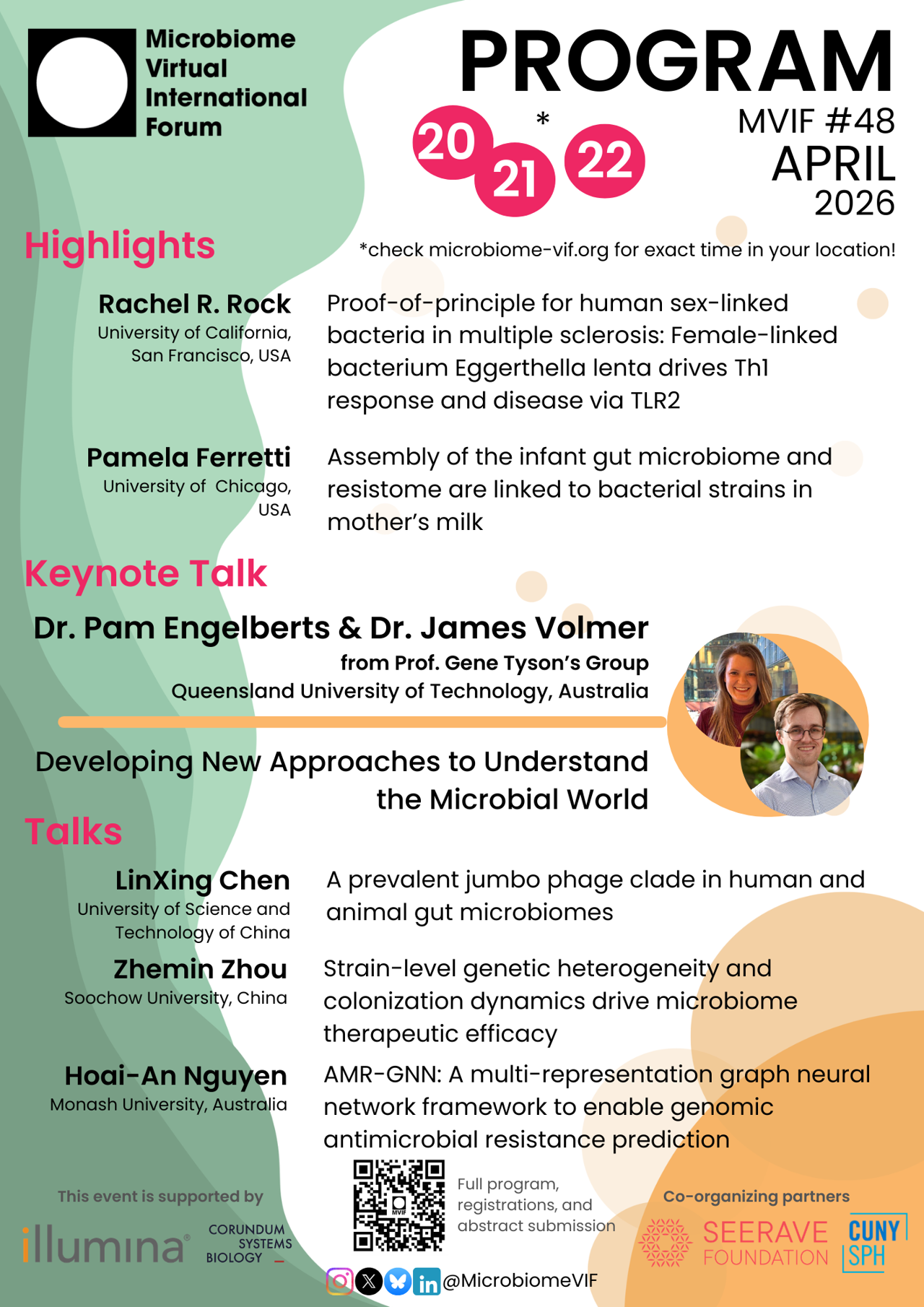

Keynote talk by Dr. Pam Engelberts & Dr. James Volmer (from Prof Gene tyson’s group)
Developing New Approaches to Understand the Microbial World
By Dr. Pam Engelberts & Dr. James Volmer, Queensland University of Technology, Australia
Highlights
Proof-of-principle for human sex-linked bacteria in multiple sclerosis: Female-linked bacterium Eggerthella lenta drives Th1 response and disease via TLR2
By Rachel R. Rock, University of California, San Francisco, USA
Women face increased risk of autoimmune disease. The human gut microbiota also differs by biological sex; however, the degree to which sex differences in the gut microbiota impact autoimmunity remains largely unexplored. A meta-analysis of 27 human cohorts revealed 91 sex-associated gut bacterial species. The top two female-enriched species, Eisenbergiella [Dialister] tayi and Eggerthella lenta, were more abundant in multiple sclerosis (MS) patients than healthy controls and positively associated with disease. E. lenta significantly worsened disease in the experimental autoimmune encephalomyelitis (EAE) mouse model, consistent with T cell infiltration and interferon-γ (IFN-γ) in the brain and T helper 1 (Th1) and T helper 17 (Th17) immune responses in the gut. E. lenta induced intestinal Th1 and Th17 signatures in healthy mice, independent of bacterial viability. TLR2 directly drives IFN-γ production in helper T cells in response to E. lenta in vitro and is necessary for E. lenta’s effect in EAE. Together, these results support a causal role for E. lenta-mediated TLR2 activation in intestinal and brain immune activation, potentially contributing to MS development. This study provides proof-of-concept for select human gut microbiota members contributing to sex biases in autoimmunity and a foundation to explore impacts of other sex-associated bacterial species.
Assembly of the infant gut microbiome and resistome are linked to bacterial strains in mother’s milk
By Pamela Ferretti, University of Chicago, USA
The establishment of the gut microbiome in early life is critical for healthy infant development. Although human milk is recommended as sole nutrition for the infant, little is known about how variation in the milk microbiome shapes the microbial communities in the infant gut. Here, we quantified the similarity between the maternal milk and the infant gut microbiomes using 507 metagenomic samples collected from 195 mother-infant pairs at one, three, and six months postpartum. Microbial taxonomic overlap between milk and the infant gut was driven by Bifidobacterium longum, and infant microbiomes dominated by B. longum showed greater temporal stability than those dominated by other species. We identified numerous instances of strain sharing between milk and the infant gut, involving both commensal (e.g. B. longum) and pathobiont species (e.g. K. pneumoniae). Shared strains also included typically oral species such as S. salivarius and V. parvula, suggesting possible transmission from the infant’s oral cavity to the mother’s milk. At one month, the infant gut microbiome was enriched in biosynthetic pathways, suggesting that early colonisers might be more metabolically independent than those present at six months. Lastly, we observed significant overlap in antimicrobial resistance gene carriage within mother-infant pairs. Together, our results suggest that the human milk microbiome has an important role in the assembly, composition, and stability of the infant gut microbiome.
Talks
A prevalent jumbo phage clade in human and animal gut microbiomes
By LinXing Chen, University of Science and Technology of China
Huge phages are widespread in the biosphere, yet their prevalence and ecology in the human gut remain poorly characterized. Here, we report Jug (Jumbo gut) phages with genomes of 360-402 kilobase pairs that comprise ~1.1% of the reads in human gut metagenomes, and are predicted to infect Bacteroides and/or Phocaeicola. Although three of the four major groups of Jug phages shared >90% genome-wide sequence identity, their large terminase subunits exhibited only 38–57% identity, suggesting horizontal acquisition from other phages. Over 1,500 genomes of Jug phages were recovered from human and animal gut metagenomes, revealing their broad distribution, with largely shared gene content suggestive of frequent cross-animal-host transmission. Jug phages displayed high gene transcription activities, including the gene for a calcium-translocating P-type ATPase not detected previously in phages. These findings broaden our understanding of huge phages and highlight Jug phages as potential major players in gut microbiome ecology.
Strain-level genetic heterogeneity and colonization dynamics drive microbiome therapeutic efficacy
By Zhemin Zhou, Soochow University, China
Fecal microbiota transplantation (FMT) has shown immunotherapeutic promise, yet its efficacy in non-small-cell lung cancer (NSCLC) remains unclear. We demonstrate that FMT improves anti-PD-1 efficacy and progression-free survival in a single-arm trial of advanced PD-L1-negative NSCLC. Analyzing over 2,000 metagenomes from diverse disease cohorts and healthy controls via a high-resolution strain-tracking framework, we reveal that phylogenetically distinct strains within identical species exert opposing therapeutic effects, resolving prior inconsistencies. We identify conserved ecological principles where engraftment relies on species-intrinsic metabolic and immune evasion traits. Crucially, successful colonization by specific beneficial strain variants correlates with positive clinical outcomes. Finally, we identify 38 priority species with robust engraftment potential and significant heterogeneity as candidates for precision therapeutics. These findings establish a strain-function-efficacy paradigm, elucidating the mechanistic basis of variable outcomes and guiding next-generation microbiome drug development.
AMR-GNN: A multi-representation graph neural network framework to enable genomic antimicrobial resistance prediction
By Hoai-An Nguyen, Monash University, Australia
Whole-genome sequencing (WGS) data are an invaluable resource for understanding antimicrobial resistance (AMR) mechanisms. However, WGS data are high-dimensional and the lack of standardised genomic representations is a key barrier to AMR phenotype prediction. To fully explore these high-resolution data, we propose AMR-GNN, a graph deep learning-based framework that integrates multiple genomic representations with graph neural networks (GNN) to enable AMR phenotype prediction from genomic sequence data. We test AMR-GNN with Pseudomonas aeruginosa, a clinically relevant Gram-negative bacterial pathogen known for its complex AMR mechanisms. We present AMR-GNN as a proof-of-concept framework designed to address several key problems in AMR phenotype prediction with data-driven machine learning (ML) approaches, including using multiple genomic representations to enhance performance, to mitigate the influence of clonal relationships and to identify informative biomarkers to provide explainability. Follow-up validation on the largest publicly available dataset spanning both Gram-negative and Gram-positive pathogens highlights AMR-GNN’s broad applicability in detecting AMR in diverse and clinically relevant pathogen-drug combinations.