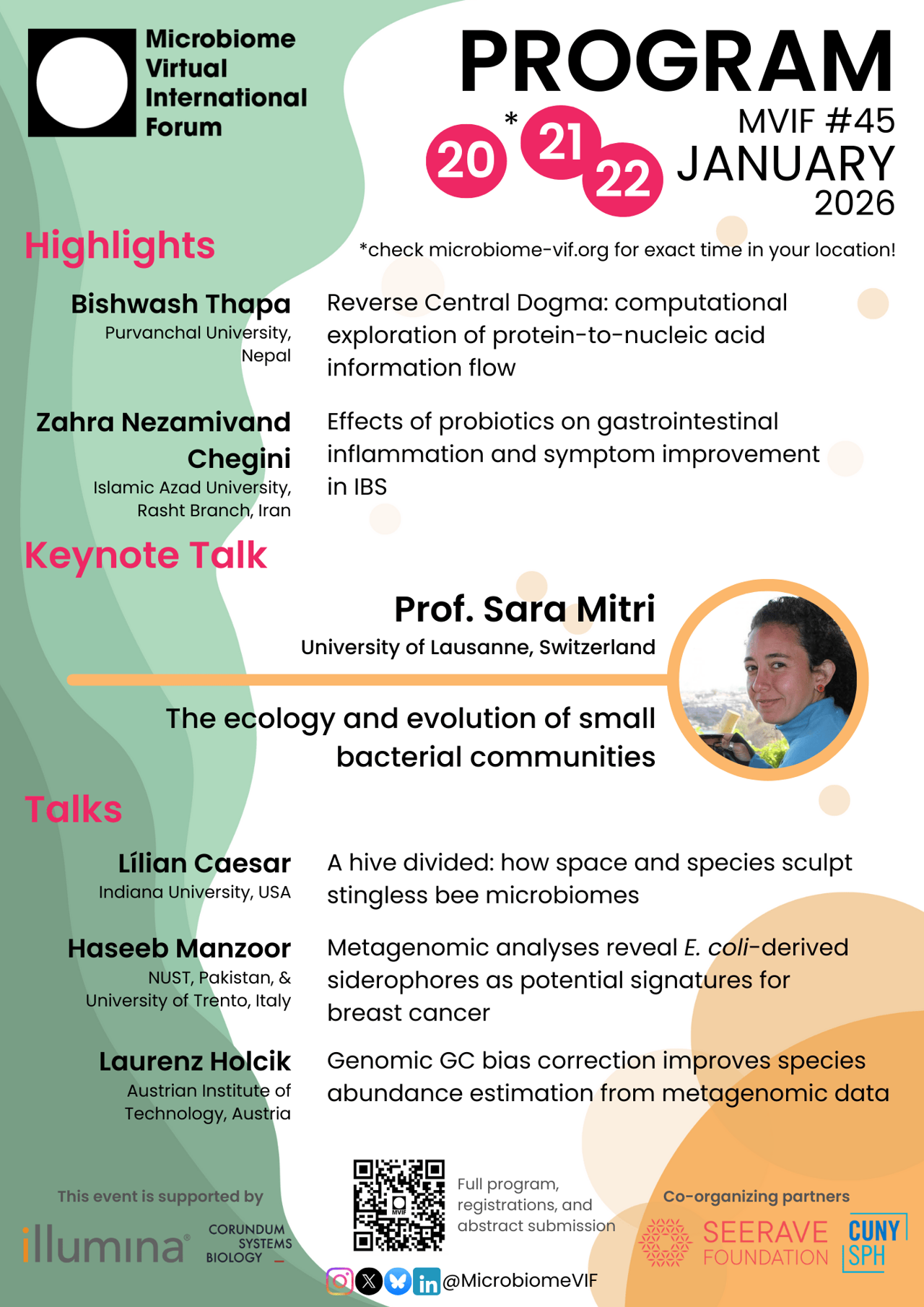

Keynote talk
The ecology and evolution of small bacterial communities
By Dr. Sara Mitri, University of Lausanne, Switzerland
Understanding how microbial communities in natural ecosystems assemble and evolve is crucial, as these communities greatly affect us and our environment. But since studying eco-evolutionary dynamics in natural systems is extremely challenging, in my lab we use small bacterial communities as model systems. I will give an overview of the work in our lab. I will first talk about how four species of bacteria interact to degrade pollutants in industrial waste waters, how these interactions are shaped by the environment over short and evolutionary timescales, and how we can use the principles of group selection to breed new communities from scratch for more efficient bioremediation. I will then present more recent work that generalises on these findings to see whether we can predict and control ecological and evolutionary dynamics in other contexts as well.
Highlights
Reverse Central Dogma: Computational Exploration of Protein-to-Nucleic Acid Information Flow
By Bishwash Thapa, Purvanchal University, Nepal
This seminar presentation synthesizes two interconnected research initiatives that together challenge conventional paradigms in molecular biology and drug discovery through advanced computational methodologies. The first project, "Reverse Central Dogma," confronts the foundational principle of molecular biology by demonstrating the theoretical feasibility of reverse information flow from proteins to nucleic acids. Through extensive molecular docking simulations involving 12 distinct peptide motifs and 4 nucleotide types, we identified statistically significant amino acid-nucleotide binding specificities, with arginine-rich peptides exhibiting exceptional preference for guanine nucleotides (ΔG = -9.8 kcal/mol, p < 0.01). We developed and validated a novel reverse translation algorithm that successfully converts protein sequences into probable nucleic acid sequences with confidence levels of 72–83%, employing Boltzmann probability distributions and Monte Carlo sampling. This work establishes a robust theoretical foundation for peptide-guided nucleic acid assembly, with profound implications for origin-of-life scenarios and synthetic biology applications.
The second project, "Seed to Lead," translates computational innovation into therapeutic potential by developing a mechanism-driven pipeline to valorize Nepalese hemp seed byproducts for cancer therapy. This research focuses on underutilized lignanamides—bioactive compounds from Cannabis seeds—and employs a three-phase computational-experimental strategy. Through in silico molecular docking, we identified promising lignanamide interactions with Nicotinamide Phosphoribosyltransferase (NAMPT), a critical enzyme in cancer metabolism. Our designed lead compound, CSE-03, demonstrates predicted moderate inhibition with high selectivity (Therapeutic Index: 3.8), addressing the historical failure of potent NAMPT inhibitors due to systemic toxicity. The project integrates phytochemical extraction, ADMET prediction, and in vitro validation to create a cost-effective blueprint for mechanism-guided drug discovery in resource-limited settings.
Collectively, this presentation illustrates how computational biology serves as a unifying bridge between theoretical innovation and applied therapeutic development. By employing shared methodologies; molecular docking, statistical modeling, and algorithm development, we simultaneously challenge six decades of biological dogma and propose novel solutions to twenty-year clinical failures. This work not only advances our fundamental understanding of biological information systems but also demonstrates a practical pathway for leveraging local biodiversity to address global health challenges, exemplifying the transformative potential of integrated computational-experimental approaches in modern biotechnology.
Effects of Probiotics on Gastrointestinal Inflammation and Symptom Improvement in IBS
By Zahra nezamivand chegini, Islamic Azad University, Rasht Branch, Iran
"Background: Irritable Bowel Syndrome (IBS) is a common functional gastrointestinal disorder characterized by abdominal pain, bloating, altered bowel habits, and low-grade inflammation. Recent evidence suggests that dysbiosis of the gut microbiota plays a central role in the pathophysiology of IBS. Probiotics, as beneficial live microorganisms, have been increasingly evaluated for their potential to modulate gut inflammation and restore microbial balance.
Objective: This mini-review aims to summarize current scientific findings regarding the effects of probiotic supplementation on reducing gastrointestinal inflammation and improving clinical symptoms in patients with IBS.
Methods: A narrative review was conducted based on studies published between 2015 and 2025, focusing on randomized controlled trials and meta-analyses evaluating probiotic strains such as Lactobacillus, Bifidobacterium, Saccharomyces boulardii, and multi-strain formulations in IBS patients.
Results: Most reviewed studies demonstrate that specific probiotic strains significantly reduce markers of intestinal inflammation, improve epithelial barrier integrity, and modulate gut microbiota composition. Clinical outcomes include reductions in abdominal pain, bloating, stool irregularity, and overall IBS severity scores. Multi-strain probiotic combinations generally show higher effectiveness compared to single-strain products.
Conclusion: Probiotic supplementation appears to be a promising, safe, and accessible therapeutic approach for mitigating gastrointestinal inflammation and improving symptoms in IBS. Further high-quality trials are needed to determine optimal strains, dosage, and treatment duration. These findings support the growing role of probiotics in gut-health–focused management strategies.
Keywords: Probiotics, IBS, Gut inflammation, Microbiome, Gastrointestinal health"
Talks
A hive divided: how space and species sculpt stingless bee microbiomes
By Lilian Caesar, Indiana University, USA
Studying host-associated microbiome assembly is key to understanding microbial and host evolution and health. While honey bee microbiome have been a central model for such investigations among pollinators, they overlook the diversity of eusocial dynamics and multi-kingdom interactions. Stingless bees—a diverse group of highly eusocial insects that includes managed species, varies in colony biology, and harbors a symbiotic yeast essential for larval development in at least one species—offer a valuable complementary system to study microbiome assembly under an eco-evolutionary context. Using amplicon sequencing, metagenomics, and microbial experiments, we investigate the drivers of microbiome assembly in stingless bee colonies. We reveal a spatially structured, site-adapted microbiome, where high microbial influx hive components are segregated from the brood, which harbors a stable, multi-kingdom community. We show that the brood microbiome is not only physically protected but also maintained through selective bacterial-fungal interactions and abiotic conditions shaped by bees and their symbionts, such as temperature and pH. Our findings uncover multi-layered mechanisms shaping eusocial superorganism microbiomes, from host biology to cross-kingdom interactions, while providing critical insights into microbiome maintenance of important pollinators.
Metagenomic analyses reveal E. coli-derived siderophores as potential signatures for breast cancer
By Haseeb Manzoor, NUST, Pakistan, & University of Trento, Italy
"Background
Breast cancer remains the leading cause of cancer-related mortality among women, highlighting the urgent need for novel insights into its biology. Recent evidence suggests the gut microbiome and its metabolites may play a role in breast cancer pathogenesis. This study investigates the gut microbiome and its predicted metabolite profiles in breast cancer patients to uncover potential mechanistic links.
Methods
Comprehensive metagenomic analyses were conducted on the gut microbiome of pre and postmenopausal breast cancer patients where microbial species were profiled through AMPHORA2 and metabolites were predicted through antiSMASH. Multivariate association analysis (MaAsLin2) was used to identify significant associations between specific microbial species, predicted metabolites, and breast cancer status. A custom ensemble machine learning classifier was developed to classify pre- and postmenopausal breast cancer cases and controls based on microbial and predicted metabolite features. Additionally, a synthetic microbiome dataset was generated through MIDASim to validate the reproducibility of the ML results. Furthermore, we proposed the underlying mechanism of E. coli-siderophore in breast cancer through literature and statistical support.
Results
Our analysis profiled 471 microbial species and predicted 40 key metabolites in the metagenomic data. Statistical analysis identified significant positive associations (p-value < 0.05) of E. coli, siderophore, and thiopeptide production, with breast cancer. The custom ensemble model achieved accuracy and AUC as high as 78% and 90%, respectively, in classifying pre and postmenopausal cases and controls. The high-ranking features, including E. coli, siderophore, and thiopeptide, supported the statistical findings and reinforced their biological relevance. Lastly, we propose a mechanistic model in which E. coli secretes siderophores under iron-limiting conditions, facilitating iron sequestration from the host, that can potentially promote angiogenesis and tumor progression.
Conclusion
Our findings suggest that microbial iron acquisition mechanisms could be critical in breast cancer pathophysiology. Further functional analyses are warranted to validate the proposed mechanisms and assess their therapeutic potential. This study highlights the gut microbiome and its predicted metabolites as promising targets for breast cancer treatment, offering new directions for research and clinical intervention."
Genomic GC bias correction improves species abundance estimation from metagenomic data
By Laurenz Holcik, Austrian Institute of Technology, Austria
Metagenomic sequencing measures the species composition of microbial communities, and has revealed the crucial role of microbiomes in the etiology of a range of diseases such as colorectal cancer. Quantitative comparisons of microbial communities are, however, affected by GC-content dependent biases. Here, we present GuaCAMOLE, a computational method to detect and remove GC bias from meta-genomic sequencing data. The algorithm relies on comparisons between individual species in a single sample to estimates the sequencing efficiency at levels of GC content, and outputs unbiased species abundances. GuaCAMOLE thus works regardless of the specific amount or direction of GC-bias present in the data and does not rely on calibration experiments or multiple samples. Applying our algorithm to 3435 gut microbiomes of colorectal cancer patients from 33 individual studies reveals that the type and severity of GC bias varies considerably between studies. In many studies we observe a clear bias against GC-poor species in the abundances reported by existing methods. GuaCAMOLE successfully removes this bias and corrects the abundance of clinically relevant GC-poor species such as F. nucleatum (28% GC) by up to a factor of two. GuaCAMOLE thus contributes to a better quantitative understanding of microbial communities by improving the accuracy and comparability of species abundances across experimental setups.