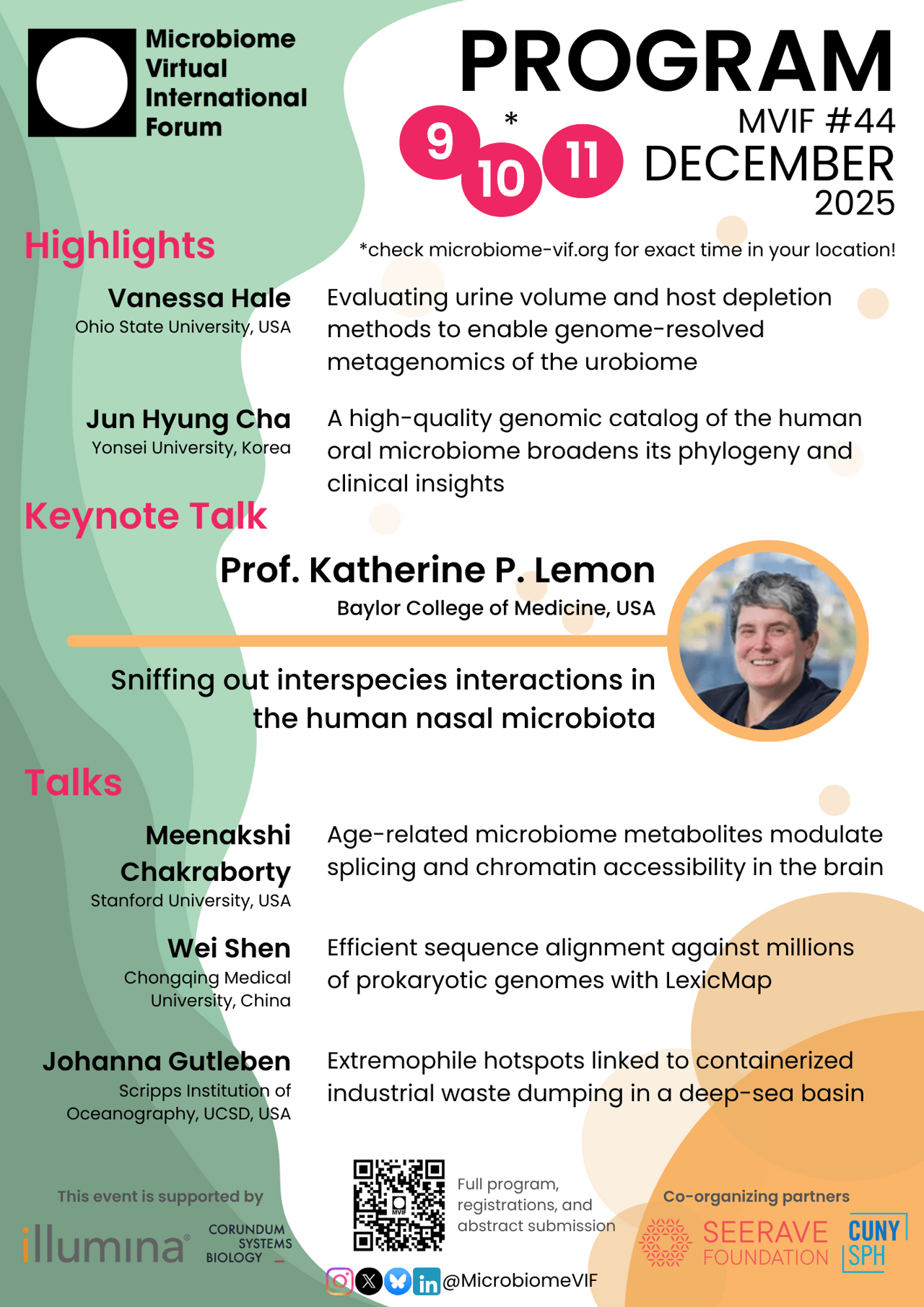
 Keynote talk
Sniffing out interspecies interactions in the human nasal microbiota
By Prof. Katherine P. Lemon, Bayor College of Medicine, USA
Highlights
Evaluating urine volume and host depletion methods to enable genome-resolved metagenomics of the urobiome
By Vanessa Hale, The Ohio State University, USA
"Background The gut microbiome has emerged as a clear player in health and disease, in part by mediating host response to environment and lifestyle. The urobiome (microbiota of the urinary tract) likely functions similarly. However, efforts to characterize the urobiome and assess its functional potential have been limited due to technical challenges including low microbial biomass and high host cell shedding in urine. Here, to begin addressing these challenges, we evaluate urine sample volume (100 ml–5 mL) and host DNA depletion methods and their effects on urobiome profiles in healthy dogs, which are a robust large animal model for the human urobiome. We collected urine from seven dogs and fractionated samples into aliquots. One set of samples was spiked with host (canine) cells to model a biologically relevant host cell burden in urine. Samples then underwent DNA extraction followed by 16S rRNA gene and shotgun metagenomic sequencing. We then assembled metagenome-assembled genomes (MAGs) and compared microbial composition and diversity across groups. We tested six methods of DNA extraction: QIAamp BiOstic Bacteremia (no host depletion), QIAamp DNA Microbiome, Molzym MolYsis, NEBNext Microbiome DNA Enrichment, Zymo HostZERO, and propidium monoazide.
Results In relation to urine sample volume, ≥ 3.0 mL resulted in the most consistent urobiome profiling. In relation to host depletion, individual (dog) but not extraction method drove overall differences in microbial composition. DNA Microbiome yielded the greatest microbial diversity in 16S rRNA sequencing data and shotgun metagenomic sequencing data and maximized MAG recovery while effectively depleting host DNA in host-spiked urine samples. As proof-of-principle, we then mined MAGs for select metabolic functions including central metabolism pathways and environmental chemical degradation.
Conclusions Our findings provide guidelines for studying the urobiome in relation to sample volume and host depletion and lay the foundation for future evaluation of urobiome function in relation to health and disease."
A high-quality genomic catalog of the human oral microbiome broadens its phylogeny and clinical insights
By Jun Hyung Cha, Yonsei University, Korea
The oral microbiome plays an increasingly recognized role in human health. To better characterize this complex ecosystem, we constructed the Human Reference Oral Microbiome (HROM), comprising 72,641 high-quality genomes representing 3,426 species, including 2,019 previously uncharacterized taxa. HROM substantially enhances metagenomic read classification compared to existing catalogs. Remarkably, it identifies 1,137 previously undescribed candidate phyla radiation (CPR) species, positioning Patescibacteria as the most dominant phylum in the oral microbiota, distinct from their environmental counterparts. Within this group, an oral CPR subclade shows a strong association with periodontitis, complementing Porphyromonas gingivalis in disease prediction. Comparative analyses between HROM and gut microbiome references further reveal marked taxonomic and functional divergence, while identifying 42 oral species detected in the gut whose relative abundance correlates with intestinal, cardiovascular, and liver disorders. Altogether, HROM provides an expanded genomic framework for the oral microbiome and underscores its potential links to systemic diseases.
Talks
Age-related microbiome metabolites alter RNA splicing and chromatin accessibility in the brain
By Meenakshi Chakraborty, Stanford University school of medicine, USA
The gut microbiome generates diverse metabolites that can enter the bloodstream and alter host biology, including brain function. Hundreds of physiologically relevant, gut-brain signaling molecules likely exist; however, there has been no systematic, high-throughput effort to identify and validate them. Here, we integrate computational, in vitro, and in vivo approaches to pinpoint microbiome-derived metabolites whose blood levels change during aging, and that induce corresponding changes in the mouse brain. First, we mine large-scale metabolomics datasets from human cohorts (each n ≥ 1200) to identify 30 microbiome-associated metabolites whose blood levels change with age. We then screen this panel in an in vitro transcriptomic assay to identify metabolites that perturb genes linked to age-related neurodegeneration. We then test four metabolites in an acute-exposure mouse model, and use multi-omic approaches to evaluate their impact on cellular functions in the brain. We confirm the known neurodegeneration-promoting effects of trimethylamine N-oxide (TMAO), including mitochondrial dysfunction, and further discover its disruptive impact on the pathways of glycolysis, GABAergic signaling, and RNA splicing. Additionally, we identify glycodeoxycholic acid (GDCA), a microbiome-derived secondary bile acid, as a potent regulator of chromatin accessibility and suppressor of genes that protect the brain from age-related, neurodegeneration-promoting insults. GDCA also acutely reduces mobility. In summary, we present a scalable framework for linking microbiome metabolites to host pathologies, and apply it to identify microbial metabolites that induce molecular changes related to neurodegeneration.
Efficient sequence alignment against millions of prokaryotic genomes with LexicMap
By Wei Shen, Chongqing Medical University, China
The size of microbial sequence databases continues to grow far beyond the abilities of existing alignment tools. We introduce LexicMap, a nucleotide sequence alignment tool for efficiently querying moderate length sequences (>250 bp) such as a gene, plasmid or long read against up to millions of prokaryotic genomes. We construct a small set of probe k-mers which are selected to efficiently sample the entire database to be indexed, such that every 250 bp window of each database genome contains multiple seed k-mers each with a shared prefix with one of the probes. Storing these seeds in a hierarchical index enables fast and low-memory alignment. We benchmark both accuracy and potential to scale to databases of millions of bacterial genomes, showing that LexicMap achieves comparable accuracy with state-of-the-art, but with greater speed and lower memory use. Our method supports querying at scale and within minutes, which will be useful for many biological applications across epidemiology, ecology and evolution. LexicMap produces output in standard formats including that of BLAST and is available under MIT license at https://github.com/shenwei356/LexicMap.
Efficient sequence alignment against millions of prokaryotic genomes with LexicMap
By Johanna Gutleben, Scripps Institution of Oceanography, UCSD, USA
Decaying barrels on the seafloor linked to DDT contamination have raised concerns about the public health implications of decades old industrial waste dumped off the coast of Los Angeles. To explore their contents, we collected sediment cores perpendicular to five deep-sea barrels. The concentration of DDT and its breakdown products were highly elevated relative to control sites yet did not vary with distance from the barrels, suggesting that they were not associated with the contamination. Sediment cores collected through white halos surrounding three barrels were enriched in calcite and had elevated pH. The associated microbial communities were low diversity and dominated by alkalophilic bacteria with metagenome-assembled genomes adapted to high pH. A solid concretion sampled between a white halo and barrel was composed of brucite, a magnesium hydroxide mineral that forms at high pH. Based on these findings, we postulate that leakage of containerized alkaline waste triggered the formation of mineral concretions that are slowly dissolving and raising the pH of the surrounding sediment pore water. This selects for taxa adapted to extreme alkalinity and drives the precipitation of “anthropogenic” carbonates forming white halos, which serve as a visual identifier of barrels that contained alkaline waste. Remarkably, containerized alkaline waste discarded >50 years ago represents a persistent pollutant creating localized mineral formations and microbial communities that resemble those observed at some hydrothermal systems. These formations were observed at one-third of the visually identified barrels in the San Pedro Basin and have unforeseen, long-term consequences for benthic communities in the region.